Showing posts with label Jesus. Show all posts

Tuesday, December 3, 2013

Mary, Mother of the Living Gospel!

From Pope Francis - 
a prayer to Mary 
to help us bring the Gospel to life today....

Mary, Virgin and Mother,
you who, moved by the Holy Spirit,
welcomed the word of life
in the depths of your humble faith:

as you gave yourself completely to the Eternal One,
help us to say our own “yes”
to the urgent call, as pressing as ever,
to proclaim the good news of Jesus.


Filled with Christ’s presence,
you brought joy to John the Baptist,
making him exult in the womb of his mother.

Brimming over with joy,
you sang of the great things done by God.

Standing at the foot of the cross
with unyielding faith,
you received the joyful comfort of the resurrection,
and joined the disciples in awaiting the Spirit
so that the evangelizing Church might be born.

Obtain for us now a new ardor born of the resurrection,
that we may bring to all the Gospel of life
which triumphs over death.
Give us a holy courage to seek new paths,
that the gift of unfading beauty
may reach every man and woman.

Virgin of listening and contemplation,Mother of love, Bride of the eternal wedding feast,
pray for the Church, whose pure icon you are,
that she may never be closed in on herself
or lose her passion for establishing God’s kingdom.

Star of the new evangelization,
help us to bear radiant witness to communion,
service, ardent and generous faith,
justice and love of the poor,
that the joy of the Gospel
may reach to the ends of the earth,
illuminating even the fringes of our world.

Mother of the living Gospel,
wellspring of happiness for God’s little ones,
pray for us.

Amen. Alleluia!
(Evangelii Gaudium, 288)

Saturday, June 22, 2013

5 simple Summery things to do!

As the summer vacation season begins, many people make a big mistake.  They take a vacation from Jesus!

Let's have a different type of summer this year.  Let's realize that this is a great time to grow in our faith and to share it. 

Here are five simple Summery things you can do:

1. Feed your faith first.  Discover a nearby summer parish while on vacation and worship there on Sundays with your new vacation community.  After all, we are called "catholic" (which means "universal" in Greek) because we are everywhere. In particular, pray for the poor and those who will never have a vacation from their labor. Use your vacation to "give back" a bit - volunteer, or give a summer offering to Catholic Relief Services or Catholic Charities, for example.

2. Sign up for tweets from Pope Francis @pontifex.  Read what he has to say each day on your smartphone. Retweet him now and again.  Also, check out his daily homilies at http://www.vatican.va/holy_father/francesco/cotidie/2013/index_en.htm  They are short and to the point.  Please let your family and friends know about these tidbits of papal wisdom.

3. Use your summer vacation to write little notes to your children and grandchildren about how much you love them!  Include a few sentences about how much you pray for them (you do, right?).  Let them know why your Catholic Faith has been so important to you through the years. And don't forget to always begin your writings (emails too!) with JMJ - Jesus, Mary and Joseph - or AMDG - Ad Majorem Dei Gloriam - for the greater glory of God - or some other phrase showing that God is first in your life.

4. Are you "connected" to the internet on vacation?  if so, maybe "disconnect" for a few days.  Chances are good that you will feel more peaceful and more attuned to the beauty around you.  Tell your internet friends the results when you "reconnect."  Give God online credit for these gifts when you reconnect.  After all, God is the maker of all good things - it is His peace and beauty you are rediscovering on vacation! 

5. Show your faith.  Wear your beautiful cross necklace.  Pray the rosary in your Adirondack chair.  Get that religious tattoo you've thought about for years - a cross, the Holy Face of Jesus, Our Lady of Guadalupe, etc. (assuming you're over 18!). Read the Bible in your cottage.  Make a summer commitment to daily morning (lauds) or evening (vespers) prayer with the Church. Read at least one religious book. When people ask you about these things, mention how much your faith means to you.  Be willing to follow up with them or refer them to someone who can answer their questions.


In a previous blog post we gave a great prayer  to say often during summer - (the Benedicite from the Book of Daniel).

Have a truly blessed summer!

Saturday, February 23, 2013

New Bible Study - all welcome!

Why read the Bible?

We should read and study the Bible because it is God's Word to us. In this busy world of ours, how can we expect to hear God speak to us? The Bible can inspire us, can support us in times of trials. It is the Bible that reveals God to us. Just as we talk about our family members, Jesus talks to us about His heavenly Father in the Bible.

Bible reading is meant to deepen our personal relationship with Christ. We become closer to each other by spending time with each other. One hour a week (Mass time) is not enough to develop a close relationship with God and His Son.

So beginning Monday Feb 25, there will be a Bible Class during Lent. We will be meeting in the Tobin Room, 6:45pm - 8pm. Note to parents of Monday night Religious Education students - this is the time you drop your students off so you can stop in and join us!  We will be discussing Jesus' Passion and Resurrection. All are welcome!

The following is an outline of the class and you are welcome to attend any night.

February 25 - Brief introduction to the New Testament - Jesus' predictions of his passion

March 4 - Jesus' entry into Jerusalem Last Supper

March 11 - Trial of Jesus and His death

March 18 - The Resurrection

Monday, December 12, 2011

Christmas basics

Here is a list of some of the basic words, images, facts, and practices of Advent and Christmas.

*the word "Christmas" is a combination of two words "Christ" and "Mass."

*the word "Nativity" is often used at this time of year.  It means "birth" and refers to the Birth of Jesus.

*the word "incarnation" is used to describe the fundamental Christian belief that the Son of God (the second Person of the Trinity) became a man. John's Gospel begins with a beautiful prologue that tells us that "the Word became flesh."

*Advent is the preparation period before Christmas.  We prepare for the coming of Jesus 1) in time, 2) at the end of time, and 3) into our hearts here and now.

*the four Sundays of Advent are marked by an Advent Wreath.  It is common in the United States to have three purple candles and one pink candle.  The pink candle is lit on the 3rd Sunday of Advent. The 3rd Sunday of Advent is sometimes called Gaudete Sunday which means "rejoice" Sunday.

*Jesus (a form of the name Joshua) means "savior."

*Messiah is a Hebrew title meaning "anointed one."  The Greek title for "anointed one" is CHRIST.  It is NOT Jesus' last name.

*a commonly used title for Jesus during Advent is "emmanuel."  This means God-with-us in Hebrew.

*the stories about the birth of Jesus are found in two Gospels - Matthew and Luke. These are sometimes called the "infancy narratives." We encourage you to read the first two chapters of Matthew and the first two chapters of Luke.

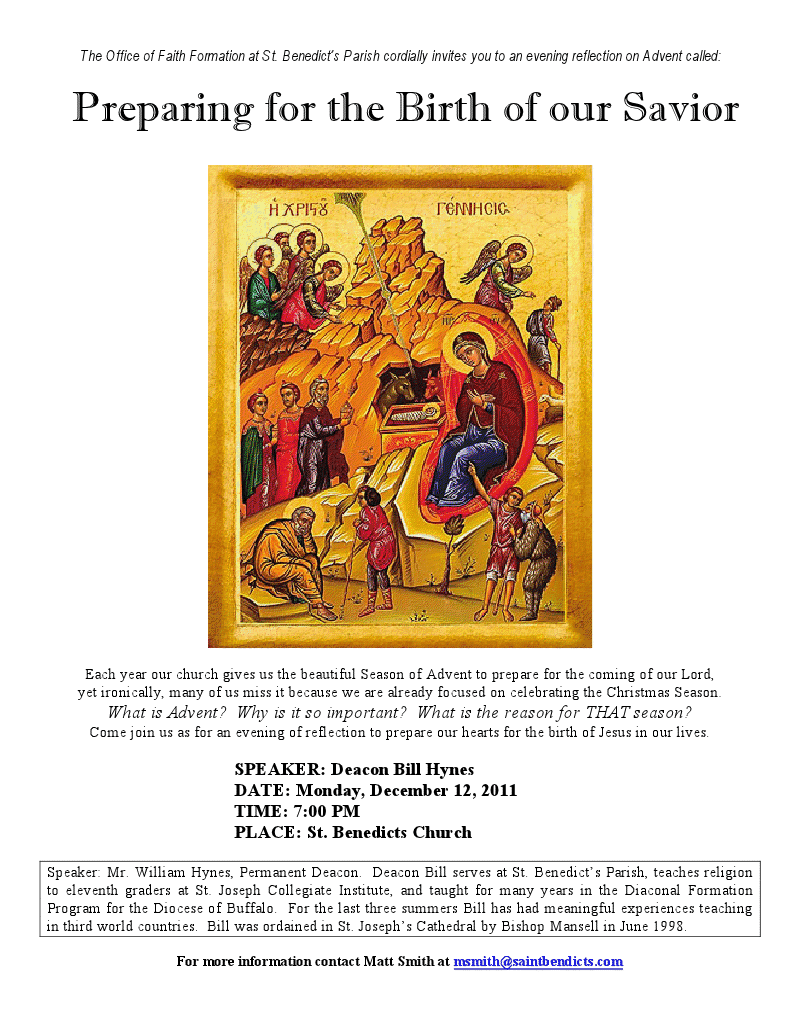
*in ancient Nativity icons, like the one above, Mary is often shown with three stars on her clothing (her two shoulders and her head). These stars symbolize her perpetual virginity. She was, by God's grace, a virgin before, during and after the birth of Jesus.

*the Eucharist figures in the stories of Jesus' birth.  He was born in Bethlehem which means "house of bread;" He was placed in a manger which is the feeding place for cattle.  He is our Bread of Life.

*a 14 point silver star now marks the spot where Jesus was believed to have been born.  It is in the Church of the Nativity in Bethlehem. The number 14 is "David's number."  That is why 14 is mentioned so often in the beginning of Matthew's Gospel.

*the swaddling clothes of Jesus at the beginning of His earthly life are meant to prefigure His burial garments at the end of His earthly life.

*the Bible never says how many Magi visited Jesus and Mary. Traditionally, since three gifts are mentioned in Matthew's Gospel, three Magi are shown in art. They were later given the names Caspar, Melchior and Balthasar. Catholics will sometimes mark their doorways on the Feast of the Epiphany (when the visit of the Magi is celebrated) with the year and the Magi initials.  Here's an example:  20+C+M+B+15.

*Although the Feast of the Epiphany is now celebrated on a Sunday in the Christmas Season, formerly it was fixed on 6 January.  From Christmas to Epiphany was called the "Twelve Days of Christmas."

*the Gospels do not call the Magi "kings."  The notion of calling them "kings" comes from Psalm 72:10.

*gold symbolizes the kingship of Jesus, frankincense symbolizes the divinity of Jesus, and myrrh symbolizes the death of Jesus.

*to show that the Magi represent all people coming to Christ, artists and creche figurines often show the Magi as men of different races. Another way of showing this "universality" is to show one magus with a long beard (old), one with a short beard (middle aged) and one without a beard (young).

Children's Pageant at St. Benedict's
Christmas Eve, 2014
*since the time of St. Francis of Assisi, we often combine the two Gospel stories (Matthew and Luke) into a creche scene.  Sometimes these creche scenes are live ("Living Nativity Scenes"), with children playing the roles of Mary, Joseph, the shepherds, etc.  Note, for example, that only Luke's Gospel mentions shepherds and only Matthew's Gospel mentions the Magi.

*often, many types of animals are included in creche scenes; however, two animals are symbolically important and should never be absent from a creche scene - the ox and the donkey.  They are included because of a prophetic verse in the Book of Isaiah (1:3): The ox knows his master, the donkey his owner's manger, but Israel does not know, my people do not understand.

*the Christmas Season ends at the Feast of the Baptism of the Lord.

Monday, September 5, 2011

Wearing Rosaries - Religious Bracelets - Jesus Pieces

As my parishioners know, I travel often and I teach religion to 16 and 17 year old boys.  I would have to say that this is about the best possible combination of activities you can have to spot male theological and fashion trends!

Rosaries I bought in NYC (Coney Island) for $1 each
 I have the sense that we are near the end of the Catholic religious bracelet trend [photo below]. I know from talking to my students, that they often had little to no idea who was on their wrist. I would teach them about the Sacred Heart of Jesus, the apparitions of Mary, or the many saints depicted on their bracelets. But I think the bracelet was not "noticeable" enough for our fashionistas. They are moving on....

The religious fashion trend that is peaking right now and will undoubtedly die out in a year or two (as all fashion trends must) is the wearing of rosaries. I see it everywhere I go.  It is particularly popular among Hispanic and African-American young men, though I see an increasing number of white men wearing rosaries too. Many of my white middle-class students wear chaplet rosaries around their wrists too. It's definitely a "guy thing." I have yet to see a woman wearing a rosary - though I'm sure some woman must have donned one somewhere!

The New York City subways are perhaps the best place to see the rosary trend in full blossom. Rosaries are now available from practically every corner vendor and kiosk operator in New York, Los Angeles, Atlanta, and just about any city with a sizable young population.

I am conflicted about this trend.

On one hand, there is the traditional side of me that thinks rosaries are private devotional aids (a sacramental) to be kept in one's pocket.  I have no doubt that the Felician Sisters who taught me in the 1970's at my parochial school would be "freaked out" by the current trend. They would think it is disrespectful that rosaries are worn as jewelry. Part of me thinks they are correct.

On the other hand, I kind of like seeing people unashamed of their faith in Jesus. I suspect many of the wearers of rosaries today do not know the Marian aspect of the rosary or the prayers that comprise it. In fact, I am pretty sure that many of those wearing rosaries are not even Catholic. However, there is no doubt that the cross/crucifix at the beginning of the rosary marks it as a Christian thing. That puts rosary beads in the category of "Jesus pieces" or "Good Wood"  or Cross pierced-earrings or Cross tattoos for many of our young fashionistas. Our young people are simply proud of being followers of Jesus.  I am proud of them for that.

So now we Catholics must evangelize a bit. The "beads" are back! Now let's make sure they are not just a piece of bling in the mind of our young folk.  Think of this as an opportunity to speak about Jesus, Mary, Catholicism and your personal faith!

Here are three suggestions:
1. FOR THOSE WHO ARE SHY - Say a quick silent prayer for the person you see wearing a rosary or a "Jesus piece." Ask Mary to intercede for them that they may grow strong in faith, hope and love. Let the rosary wearer strengthen your faith too by reminding YOU of Christ and the Blessed Mother!
2. FOR THOSE WHO ARE A BIT BRAVER - Use rosaries as a conversation starter if you feel comfortable speaking to the wearer.  If you have rosaries in your pocket, (and shouldn't you?) take them out and compare.  Briefly tell your rosary story - when you got it, what it means to you, and especially how often you USE your rosary. Let them tell their rosary story. Maybe, just maybe, you will even trade rosaries!
3. FOR THOSE WITH HEROIC ZEAL & COURAGE - teach them the rosary. Have a card with instructions on praying the rosary in your pocket. The Knights of Columbus have a handy card - http://www.kofc.org/un/en/resources/cis/devotionals/1877.pdf  Make sure you have previously written the directions to your parish and its Sunday Mass times on the cards too.

Another useful site for learning to pray the rosary:
http://www.newadvent.org/images/rosary.pdf

Whatever your personal view on fashion trends, now is the time for us to catechize our young people. They have taken the first step by adopting our iconography and sacramentals, so let us use their fashion sense to share the Good News of salvation!

Sunday, August 14, 2011

Statues of St. Benedict's


St. Benedict - transept
explanation below
We are blessed with many beautiful works of art in our parish. Our windows are truly spectacular, as is the Gothic architecture of our church building.  However, for Catholics, it goes without saying that all art pales in comparison with the glory of God and the glory of His people.  We Catholics surround ourselves with sacred images to remind us of our family. We never worship images; we worship only God. But we never worship alone.

Here is what the Catechism of the Catholic Church says about sacred art : 
2502 Sacred art is true and beautiful when its form corresponds to its particular vocation: evoking and glorifying, in faith and adoration, the transcendent mystery of God - the surpassing invisible beauty of truth and love visible in Christ, who "reflects the glory of God and bears the very stamp of his nature," in whom "the whole fullness of deity dwells bodily."(Heb 1:3; Col 2:9). This spiritual beauty of God is reflected in the most holy Virgin Mother of God, the angels, and saints. Genuine sacred art draws man to adoration, to prayer, and to the love of God, Creator and Savior, the Holy One and Sanctifier.


Our statues of Jesus are the most important of course. Here is the crucifix over our altar. Jesus is the center of our Church and the center of our parish.


Crucifix in natural light


On the right side of the main altar, we have a side altar dedicated to the Sacred Heart of Jesus.  As you know, the Sacred Heart of Jesus is also shown in the western transept window as well. It is a presentation of Jesus, accenting his humanity, that comes from the visions of St. Margaret Mary Alacoque. 


Perhaps the one statue of Jesus that needs explanation is the small Infant of Prague statue in the transept.


Here the Child Jesus is shown crowned and holding a globe surmounted by a Cross. This signifies Christ's Kingship over all. His right hand is shown in the traditional symbolic gesture used on icons and art work of Christ. The two fingers symbolize the hypostatic union (Jesus is BOTH God and man). The three fingers symbolize the Trinity (Father, Son and Holy Spirit).


Mary, whose titles include the "Blessed Virgin" and "Theotokos" (Mother of God), is well represented at St. Benedict's.  Here are some photos of our statutes of Mary...

Mary statue with Butterfly plant - Main Street

snake at base of Marian statue - detail
see Genesis 3:15 - the protoevangelion
and Revelation 12 - "the moon under her feet"

face of Mary - side altar statue, detail


Mary with Christ Child - rectory garden

We have a wonderful statue of St. Joseph in our transept.  St. Joseph is the Patron saint of the whole Church and of the Diocese of Buffalo.  That is why Joseph gets a special place opposite our parish patron, Benedict.
St. Joseph - transept

St. Joseph and the Child Jesus - detail

Our patron, Saint Benedict, is also one of the patrons of Europe and of monks.Our transept statue was the first one in this article. He is shown as an abbot carrying a crozier and the Rule of his Benedictine Order (the book he carries).  Benedict is often shown with a dove as well.  He saw the soul of his sister, St. Scholastica (we have a window of her in the sacristy), rise to heaven like a dove.

Here is our outside statue of St. Benedict on the Eggert Road side of the church.

St. Benedict - outside, Eggert Road
St. Francis of Assisi, Il Poverello (the little poor one) also has statues inside and outside of our church. Here is our inside statue of Deacon Francis:
St. Francis - inside

skull from base of St. Francis statue - Sister Death
  
St. Francis, school garden
in remembrance of the Franciscan Sisters who taught in our school

St. Anthony of Padua has a statue in our transept. Here he is shown with the Child Jesus. He is often invoked to help find lost objects.

St. Anthony of Padua - transept statue

The two patron saints of missionaries are represented in St. Benedict's. There is a transept window of the great Jesuit, St. Francis Xavier (who did mission work in Asia).

There is a statue of the great Carmelite, St. Therese of Lisieux (who wanted to be a missionary but could not).  St. Therese is sometimes called the "Little Flower."  Known for her great humility, her statue is an obvious place to end this presentation.

St. Therese of Lisieux, the Little Flower - transept


Friday, August 12, 2011

The Bible & The Mass - a study series

A Biblical Walk through THE MASS and
The New Translation of THE MASS

Please join us for 5 one-half hour sessions on Wednesday evenings beginning September 14th at 6:30pm in the Tobin Room (Use Eggert Rd. Lot, door #5). Contact 833-6138, Allan Cecchini.

From the time of the apostles, the Mass has been the central act of Christian worship. For the Mass is nothing less than the celebration of the Eucharist that Jesus instituted at the Last Supper, when he commanded his apostles, "Do this in memory of me". (see Luke22:19)
     With this course, The Great Adventure moves from studying particular books and sections of the Bible to studying the Scriptural roots of the liturgy. For many Catholics, the Mass might, at least in a certain sense, be almost too familiar. We show up to church each Sunday and perform prayers and rituals that many of us have known since childhood, We stand, sit, and kneel. We make the sign of the cross. We recite "Holy, Holy, Holy," "Lamb of God," and "Thanks be to God". But do we really understand the significance of all that we are saying and doing in the liturgy?
     "The way in which the Mass is celebrated has undergone various changes throughout the centuries, but the heart of the liturgy has remained the same. It continues to be a celebration of the banquet of the Lord, in which Catholics come to hear the word of God in the Scriptures and receive the body and blood of Christ in the Eucharist.
     As we prepare to welcome the revised English translation of the Mass, we can be assured that the Eucharist we celebrate will stand in continuity with that first Eucharist institute by Christ-and that the new translation is intended to help enhance out worship of God and deepen our participation in the  sacred mysteries of the liturgy." (Edward Sri, A Guide to the New Translation of The Mass, 2011)

     Please join us for 5 one-half hour sessions on Wednesday evenings beginning September 14th at 6:30pm in the Tobin Room. 833-6138, Allan Cecchini.

Please join us for our workshop on the new English Revision of the Mass.  It will be held on Wednesday 26 October at 7:00 p.m. in our church.  Please invite others as well.  That is one month before the new spoken responses go into effect.

Tuesday, July 19, 2011

Salt and Light Group - Catholic Social Teaching

Perhaps no one has as clearly and beautifully stated the purpose of our Salt & Light group as Pope Francis in a letter to British Prime Minister David Cameron, MP (15 June 2013) - (click for full text)

...the goal of economics and politics is to serve humanity, beginning with the poorest and most vulnerable wherever they may be, even in their mothers' wombs. Every economic and political theory or action must set about providing each inhabitant of the planet with the minimum wherewithal to live in dignity and freedom, with the possibility of supporting a family, educating children, praising God and developing one's own human potential. This is the main thing; in the absence of such a vision, all economic activity is meaningless.

In this sense, the various grave economic and political challenges facing today's world require a courageous change of attitude that will restore to the end (the human person) and to the means (economics and politics) their proper place. Money and other political and economic means must serve, not rule, bearing in mind that, in a seemingly paradoxical way, free and disinterested solidarity is the key to the smooth functioning of the global economy.


Our Salt & Light group takes its name from the sayings of Jesus in Matthew 5:13-14: "You are the salt of the earth...You are the light of the world..." We are called to imitate Christ Jesus by serving others. The image to the right shows Jesus washing the feet of His apostles. He instructs them to do the same. As Jesus' disciples today, we carry out His mandate to become servants of peace and justice.

The dignity of the human person and the common good are key elements of our work and prayer.

The Salt & Light group of St. Benedict's Parish strives to make Catholic Social Teaching (CST) a reality. It is open to anyone interested in Peace and Justice issues. Examples include: life issues and bioethics (we work closely with our Respect Life Ministry on these), care for the environment, immigration, economic justice, global poverty, human trafficking, and unemployment/underemployment. With the charitable organizations of our parish, we attempt to focus on root causes of injustice, Catholic advocacy and education.

We usually meet once a month for approximately one hour. Our meetings begin with a reading from the Gospel, we introduce ourselves, receive an update on the progress of current projects, take some time to study and discuss part of a papal social encyclical or a document of the US Catholic Bishops, have an open discussion, ask for new ideas, and close with a simple prayer. We communicate often via email on current projects. Members receive periodic e-mailings from the Diocese of Buffalo on CST issues as well.

We would love to have you take part in our Salt & Light group. For information, please contact rectory@saintbenedicts.com or simply attend a meeting.

*****
To share this blog post - http://bit.ly/nnI1EU

Monday, July 18, 2011

Thoughts on the Lord's Prayer - M. Smith

Knowing a Prayer Backwards + Forwards
by Matthew R. Smith

I am a self-diagnosed dyslectic:
I am a terrible speller, slow reader,
I am always inverting letters and numbers, and it seems like
I am always getting things backwards;
but I am not complaining,
these problems also have there pluses and perks.

It is helpful to read scripture, philosophy, poetry,
theology, and other scholarly writing, slowly...
(and these are all genres I enjoy),
and sometimes I find that by turning things around
I can see things in new, important and meaningful ways.

The Lord's Prayer is a good example, it is
so familiar,
so central to the Christian faith, and repeated
so many times throughout the life of a Christian,
that I think all Christians would say they know that prayer
"backwards and forwards"...
but have you ever actually read the prayer backwards?

I have.

I think such an exercise is beneficial,
but before I explain why,
I have to turn you around and take you back in time,
back to the "Old" Testament (which would have
been the primary Sacred Scriptures for Jesus and the first disciples),
the book of Exodus takes central stage in the story of
the Hebrew people and the Jewish faith.

It is in the story of the book of Exodus we read:
that Moses encounters God in the burning bush,
that Moses receives the Ten Commandments
(the core teachings of the faith),
that Moses leads an enslaved people to freedom.

It is in the book of Exodus that an oppressed, estranged and persecuted
people are freed from bondage and formed into a people
under God's direction in search for the promised land.

The Exodus experience lays at the heart of the Jewish faith.

Could it be that, just as The Last Supper is a recapitulation of
the Passover (also part of Exodus), that the Lord's Prayer is
a recapitulation, a retelling, a re-imagining of the whole Exodus
story?

Exodus and the Lord's Prayer
Jesus was a Jew. Jesus was a Rabbi.
Jesus was steeped in Scripture (the "Old" Testament).
Jesus would have used the Hebrew Scripture just as Christians focus on the
New Testament. When Jesus prayed, the stories of the Sacred Scripture
would have been part of his religious world view. The Exodus experience
would have been part of his "religious DNA." To get inside the Lord's
Prayer, to pray as Jesus did, we need to think like a Jew, we need to
think like a Rabbi.


DELIVER US FROM EVIL
Who ends a prayer with the word "evil"? Jesus did.
Evil is a reality that most people would rather ignore (or mask),
but every time we pray the Our Father
we are asking to escape (and really be free of) this reality.
Is there evil in your life which you need deliverance from?
If you can not answer that question, then this prayer might not speak
strongly to you just now.

If you were a slave, if you were in bondage, if you were persecuted, if you did not have enough to eat,
if you were controlled and your life was not your own (of if you love someone who is suffering in this way)
then I think a prayer for deliverance would be more meaningful to you.

Israel, the promised land, was occupied
and ruled by the Roman Empire when Jesus
first taught the disciples how to pray.
The story of Exodus is the story of deliverance
from the evil of slavery in Egypt.
Exodus means "exit"... to leave.
The Hebrew people left evil and learned to
walk with God.

LEAD US NOT INTO TEMPTATION
As miraculous as it was for the Hebrew people to get out of Egypt,
perhaps the bigger miracle is that they did not go back on their of their own free will.
The wandering in the wilderness was difficult, even harder than being a slave
in some ways. Even Jesus was tempted in the wilderness.
The Hebrew people found their time in the desert filled with temptation,
and many times they gave into their desires.
At one point they worshiped other gods so that they might once again
have some of the comforts they once enjoyed.

FORGIVE US OUR DEBT AS WE FORGIVE OTHERS
The road from slavery to liberty was difficult and crooked;
they got lost and turned from God from time to time and needed forgiveness.

Because the Hebrew people were redeemed slaves, making sure other
people would not befall the same fate became part of their ethic.
Forgiveness of debt is expounded upon in the book of Leviticus
in the concept of Jubilee.
If we ask God to free us, we must be willing to free others.
Much of the world is in bondage and servitude today due to third world debt.
The Lord's Prayer is also a prayer of liberation.

GIVE US THIS DAY OUR DAILY BREAD
While the Hebrews were wandering in the wilderness God
gave them mana from heaven each day. A key way that the Hebrew
people made it to the promised land was they learned to rely on God
for their needs.

YOUR WILL BE DONE, ON EARTH AS IT IS IN HEAVEN
Freedom from Pharaoh did not mean the Hebrew people were free to
do what ever they wanted. The Exodus story is also about receiving the
Ten Commandments. Pharaoh's laws brought slavery and death, God's
laws bring true freedom and life. In the last decade there has been a
lot of talk about "regime change" whether it be Libya, Egypt, Afghanistan or
Iraq. The Exodus story is about regime change too... this time God is in charge.

YOUR KINGDOM COME
The hope of the freed people of Egypt was to find the promised land.
They sought Jerusalem "the abode of peace"... they sought to return to Eden
where once again there would be harmony and peace with God, neighbor and nature.

HALLOWED BE THE NAME
Among the Ten Commandment, the first four speak of the priority of God in life.
The third commandment specifically warns against the misuse of God's name.
This line of the Lord's Prayer also evokes the Epiphany, Moses' encounter
with God in the burning bush, where Moses learns the divine name as
he stands on holy ground.

OUR FATHER IN HEAVEN
God is both transcendent, beyond our realm of understand and also intimately related to us,
and cares for us, like a loving parent. God, according to the
Exodus story, hears the cry of the poor and intervenes in history bringing justice
and peace. God saves.


Now let's look at the Lord's prayer forward again.
The name "Jesus" means "Yahweh saves" or "God saves." When we pray the "Our Father" we become like our Savior, we are acknowledging that we are a child of God, like the Son of God, who seeks to bring the whole world to freedom, liberation and salvation.


Thanks for listening as I turned things upside down.
Sometimes by going backwards (like going on a retreat), it can help us to move forward.
In going back and seeing the importance of Exodus I believe we
can see the Lord's Prayer as a call for a new liberation
in our hearts and the world.


Further Reading: [I thought I may have been on to an original idea
so I googled "Exodus and the Lord's Prayer" and found someone beat
me to the idea over ten years ago... here is a very good paper].
http://www.ntwrightpage.com/Wright_Christian_Prayer.htm

Saturday, April 30, 2011

Good Friday's Crucifix - a work of love


A Parish Treasure
I am so moved every Good Friday when I see the whole parish venerating the cross. It is such a beautiful procession of young and old, rich and poor, all bowing to venerate the image of Jesus Christ on the crucifix. Some kiss His feet or His hands.  Some touch His wounds.  Some gaze reverently into His eyes.  All join in contemplation of the supreme sacrifice. 

"We adore You O Christ and we bless You; because by Your Holy Cross You have redeemed the world!"

I am so glad I asked about our beautiful crucifix this year.

It turns out that this crucifix, which usually hangs in the school cafeteria, has an amazing history of its own. Mrs. Grace Neureuther shared the story and her photos with us.  Her husband Ross handcarved this crucifix for the parish. It was blessed by Fr. Gary Bagley on December 8, 2004. Ross has passed on to his eternal reward, but his blessed memory and his beautiful handiwork live on.   Thank you Ross and Grace!


The planning stage


Ross with the Body of Christ


Ross holding the finished Crucifix

A close-up


Dedication on the back

A thank you note from our School
"We adore You O Christ and we bless You; because by Your Holy Cross You have redeemed the world!"

*****
Share this blog post - http://bit.ly/kFAhWV

Thursday, April 14, 2011

Easter Baskets Blessing and Food Symbolism

from wikimedia commons
Symbolism of Traditional Easter Foods followed by the Blessing of Easter Baskets

Certain Easter food items are traditionally brought to church in a basket on Holy Saturday to be blessed.

We bless baskets at 3:00 PM Holy Saturday in our beautiful church of St. Benedict. The blessed food is then used for the first Easter meal. 


Here is a wikipedia link on this custom, (sometimes called ÅšwiÄ™conka) - http://bit.ly/HeUQ8U.

The following information about the symbolism of the foods blessed in baskets is based on In the Home: Blessing of Foods at Easter by Madeline L. Brock

Butter Lamb – through the blood of the lamb, the Israelites were saved (Ex. 12). Jesus is our Passover or Paschal Lamb who takes away the sins of the world (John 1:35-36).

Horseradish – represents the bitter herbs eaten in the Passover meal as a reminder of the bitterness of slavery in Egypt (Ex. 12).

Bread – a Passover food (Ex. 12) and a reminder of Jesus in the Eucharist, the true bread of everlasting life (John 6).

Wine – the drink of the Passover meal and the Last Supper (Mt. 26:26-30). A reminder of the Blood of Christ.

Ham/Sausage – Pork was prohibited in the Old Testament. The New Testament, however, gives freedom (Acts 15). Sausage links show the chains of death Jesus broke at Easter (Exsultet).

Eggs – Jesus breaks forth from the tomb as a chick breaks from its shell. It is fitting to decorate eggs as a sign of our belief in Christ’s Resurrection.

Children’s Easter baskets filled with candy are an imitation of the food baskets brought to Church for the blessing of the first Easter meal.

A Prayer service and blessing for Easter Foods, comprised primarily of Biblical readings.

Here is the Catholic blessing for Easter foods (from the Book of Blessings, 1707 ff.):

INTRODUCTORY RITES
1707 When the community has gathered, a suitable song may be sung.
The minister says: In the name of the Father, and of the Son, and of the Holy Spirit.
All make the sign of the cross and reply: Amen.

1708 The minister greets those present in the following or other suitable words, taken mainly from sacred Scripture.

A) Before the Easter Vigil - For our sake Christ became obedient, accepting even death, death on a cross. Therefore God raised him on high and gave him the name above all other names. Blessed be God for ever.
And all reply: Blessed be God for ever.

B) After the Easter Vigil - Christ is risen. Alleluia.
And all reply: He is risen indeed. Alleluia.

1709 In the following or similar words, the minister prepares those present for the blessing.
Throughout Lent we have been preparing for the resurrection of the Lord by prayer, almsgiving, and fasting. Our lenten fasting is a reminder of our hunger and thirst for holiness which is satisfied only by Christ who feeds and nourishes us by his word and sacraments. When we gather at our first meal of Easter may this food be a sign for us of that heavenly banquet to which the Lord calls us.

READING OF THE WORD OF GOD
1710 One of those present, or the minister, then reads a text of sacred Scripture. Brothers and sisters, listen to the words of the book of Deuteronomy 16:1-8 The passover of the Lord.

Observe the month of Abib by keeping the Passover of the LORD, your God, since it was in the month of Abib that he brought you by night out of Egypt. You shall offer the Passover sacrifice from your flock or your herd to the LORD, your God, in the place which he chooses as the dwelling place of his name. You shall not eat leavened bread with it. For seven days you shall eat with it only unleavened bread, the bread of affliction, that you may remember as long as you live the day of your departure from the land of Egypt; for in frightened haste you left the land of Egypt. Nothing leavened may be found in all your territory for seven days, and none of the meat which you sacrificed on the evening of the first day shall be kept overnight for the next day.

You may not sacrifice the Passover in any of the communities which the LORD, your God, gives you; only at the place which he chooses as the dwelling place of his name, and in the evening at sunset, on the anniversary of your departure from Egypt, shall you sacrifice the Passover. You shall cook and eat it at the place the LORD, your God, chooses; then in the morning you may return to your tents. For six days you shall eat unleavened bread, and on the seventh there shall be a solemn meeting in honor of the LORD, your God; on that day you shall not do any sort of work.

1711 Or: Isaiah 55:1-11--Come all you who are thirsty. Luke 24:13-35--They knew Christ in the breaking of the bread. John 6:1-14--Multiplication of the loaves.

1712 As circumstances suggest, one of the following responsorial psalms may be sung, or some other suitable song.

R. My soul is thirsting for God, the living God.

Psalms 42 and 43 Athirst is my soul for God, the living God. When shall I go and behold the face of God? R.

Those times I recall, now that I pour out my soul within me, When I went with the throng and led them in procession to the house of God, Amid loud cries of joy and thanksgiving, with the multitude keeping festival. R.

Send forth your light and your fidelity; they shall lead me on And bring me to your holy mountain, to your dwelling-place. R.

Then will I go in to the altar of God, the God of my gladness and joy; Then will I give you thanks upon the harp, O God, my God! R.


Psalm 104:1-2, 5-6, 10, 12, 13-14, 24, 35 R. (v. 1) Bless the Lord, 0 my soul.

1713 As circumstances suggest, the minister may give those present a brief explanation of the biblical text, so that they may understand through faith the meaning of the celebration.

INTERCESSIONS
1714 The intercessions are then said. The minister introduces them and an assisting minister or one of those present announces the intentions. From the following those best suited to the occasion may be used or adapted, or other intentions that apply to the particular circumstances may be composed.

The minister says: The Son of God who invites us to the Paschal feast stands ready to help. Let us call upon him in our need.

R. Lord, prepare us for the feast of life.

Assisting minister: That Easter may find us cleansed of sin and ready to live anew our Christian faith, we pray to the Lord. R.

Assisting minister: That the bread we share may be a reminder of the bread of life we share in the eucharist, we pray to the Lord. R.

Assisting minister: That we may be ready to give from our table to those who hunger and thirst, we pray to the Lord. R.

Assisting minister: That we may one day enjoy the banquet of the Lord in the heavenly kingdom, we pray to the Lord. R.


1715 After the intercessions the minister, in the following or similar words, invites all present to sing or say the Lord's Prayer. Christ taught us to pray for our daily bread and so we dare to say:

All: Our Father . . .

PRAYER OF BLESSING
1716 A minister who is a priest or deacon says the prayer of blessing with hands outstretched; a lay minister says the prayer with hands joined.

God of glory, the eyes of all turn to you as we celebrate Christ's victory over sin and death.
Bless us and this food of our first Easter meal. May we who gather at the Lord's table continue to celebrate the joy of his resurrection and be admitted finally to his heavenly banquet.
Grant this through Christ our Lord.
R. Amen.

CONCLUDING RITE
1717 A minister who is a priest or deacon concludes the rite by saying: May Christ always nourish you and strengthen you in faith and love, now and for ever. R. Amen.

Then he blesses all present. And may almighty God bless you all, the Father, and the Son, + and the Holy Spirit. R.Amen.

1718 A lay minister concludes the rite by signing himself or herself with the sign of the cross and saying: May Christ nourish us and strengthen us in faith and love now and for ever. R.Amen.

1719 It is preferable to end the celebration with a suitable song.


II. SHORTER RITE
1720 The minister then greets those present in the following or other suitable words, taken mainly from sacred Scripture.

A) Before the Easter Vigil For our sake Christ became obedient, accepting even death, death on a cross. Therefore God raised him on high and gave him the name above all other names. Blessed be God for ever.

And all reply: Blessed be God for ever.

B) After the Easter Vigil - Christ is risen. Alleluia.
And all reply: He is risen indeed. Alleluia.


1721 One of those present or the minister reads a text of sacred Scripture, for example: Brothers and sisters, listen to the words of the book of Deuteronomy 16:1-8

The passover of the Lord. Observe the month of Abib by keeping the Passover of the LORD, your God, since it was in the month of Abib that he brought you by night out of Egypt. You shall offer the Passover sacrifice from your flock or your herd to the LORD, your God, in the place which he. chooses as the dwelling place of his name. You shall not eat leavened bread with it. For seven days you shall eat with it only unleavened bread, the bread of affliction, that you may remember as long as you live the day of your departure from the land of Egypt; for in frightened haste you left the land of Egypt. Nothing leavened may be found in all your territory for seven days, and none of the meat which you sacrificed on the evening of the first day shall be kept overnight for the next day.

You may not sacrifice the Passover in any of the communities which the LORD, your God, gives you; only at the place which he chooses as the dwelling place of his name, and in the evening at sunset, on the anniversary of your departure from Egypt, shall you sacrifice the Passover. You shall cook and eat it at the place the LORD, your God, chooses; then in the morning you may return to your tents. For six days you shall eat unleavened bread, and on the seventh there shall be a solemn meeting in honor of the LORD, your God; on that day you shall not do any sort of work.

1722 Or: Isaiah 55:1-11--Come all you who are thirsty. Luke 24:13-35--They knew Christ in the breaking of the bread.

1723 A minister who is a priest or deacon says the prayer of blessing with hands outstretched; a lay minister says the prayer with hands joined.

God of glory, the eyes of all turn to you as we celebrate Christ's victory over sin and death.
Bless us and this food of our first Easter meal. May we who gather at the Lord's table continue to celebrate the joy of his resurrection and be admitted finally to his heavenly banquet.
Grant this through Christ our Lord.
R. Amen.

Prayer Source: Book of Blessings by Prepared by International Commission on English in the Liturgy A Joint Commission of Catholic Bishops' Conferences, The Liturgical Press, Collegeville, Minnesota, 1989

Monday, February 28, 2011

Ash Wednesday - 15 Hours of Ashes


ASH WEDNESDAY
St. Benedict's

15 HOURS OF ASHES
Return to the Lord!
Please join us at any time from 6:00 am right through 9:00 pm on Ash Wednesday, March 9th.

We have masses at 7 am, 8:15 am and 7pm.  There is a prayer service at 12 noon. We highly encourage your participation in our liturgies and prayer service. Ashes will be distributed during Mass and at the prayer service.

Additionally, between 6am and 9pm, we will also be distributing ashes to those who wish to turn back to the Lord.  Whether you have been away for one day, one year, or haven't set foot in a Catholic Church in decades, we invite you to receive ashes as a sign of repentance and continual conversion.  You are welcome here! And you are welcome to receive ashes at anytime between 6am and 9pm at St. Benedict's.

Ashes are a biblical sign of penance. Here are some Biblical verses mentioning ashes - Jeremiah 6:26, Isaiah 58:5, Daniel 9:3, Matthew 11:21 and Luke 10:15. Ashes in the Catholic Church are the burnt remains of last year's palms used on Palm Sunday.  Ashes are placed on your forehead as a sign to others of your change of heart. You may hear either of these prayers as the minister puts ashes on your forehead: "Remember that you are dust and to dust you will return,"  OR "Turn away from sin and be faithful to the Gospel."

At Mass on Ash Wednesday, we hear the prophet Joel exclaim "rend your hearts, not your garments and return to the LORD, your God."  Can you hear God's call within you?

Perhaps the most amazing result of keeping St. Benedict's Church open all day, as we have the past three years, is seeing the hundreds of people, from all walks of life, truly striving to reform their lives.  Three of our four priests (how blessed we are as a parish to have FOUR priests!) are kept busy all day hearing confessions of people who want a fresh spiritual start. [Say a prayer for our Pastor, Fr. Joseph Porpiglia, who is in Rome on sabbatical.]

Will you repent with us this year?  Don't worry if you forgot how to go to confession; we have information about the sacrament ready for you. 

Please invite all your friends and family members to join us Ash Wednesday. Directions are available under our Visitor tab on our website http://www.saintbenedicts.com/.
 
We are here to be the welcoming hands of Christ. 
Return to the Lord!
*****
Share this blog post - http://bit.ly/gflWQF

Thursday, February 17, 2011

St. Joseph's Day Table March 20

The St. Joseph's Day Table was a huge success!
Thank you for joining us.
Please make plans to join us again next year.
A special "thank you" to all our volunteers!

The photos are in...


The St. Vincent de Paul Society (http://bit.ly/f7egIy) is sponsoring a St. Joseph Table on March 20th 2011 at 4:00 pm at Saint Benedict Church, 1317 Eggert Rd. Amherst, NY. There will only be one seating at 4:00 pm. Tickets are $20.00 for adults and $5.00 for children who are having spaghetti only. There will be only 200 tickets sold, but we will offer take out service for families of 4. Tickets will be on sale after all Masses and in the rectory.

For information or tickets please call Agnes at 832-2086 or email mattandag@mac.com

Here's the menu:
*Zuppe- Lentils and Rice
    (A time honored St. Joseph's Day tradition to start the meal)
*An Intermezzo of Hard-boiled Egg, Orange, and a Relish Tray.
*Pasta Consardi
    (A full flavored red sauce with sardine over spaghetti - red sauce available)
*Insalata-
   (A fresh, Italian fully dressed salad.)
*Entree
   (A Loin of Cod, Stuffed Hot Peppers & Fritattas of Spinach/Artichoke)
*Desserts of Cannoli, Cookies and Coffee


THANK YOU and Viva San Giuseppe!
*****
Share this Blog post - http://bit.ly/gyhPha